SúFlair Hair Studios
A mobile-first storefront and admin portal combining salon service booking with a raw hair extension shop, running on AWS.
- Client
- SúFlair Hair Studios
- Delivered
- Engagement
- Fully remote
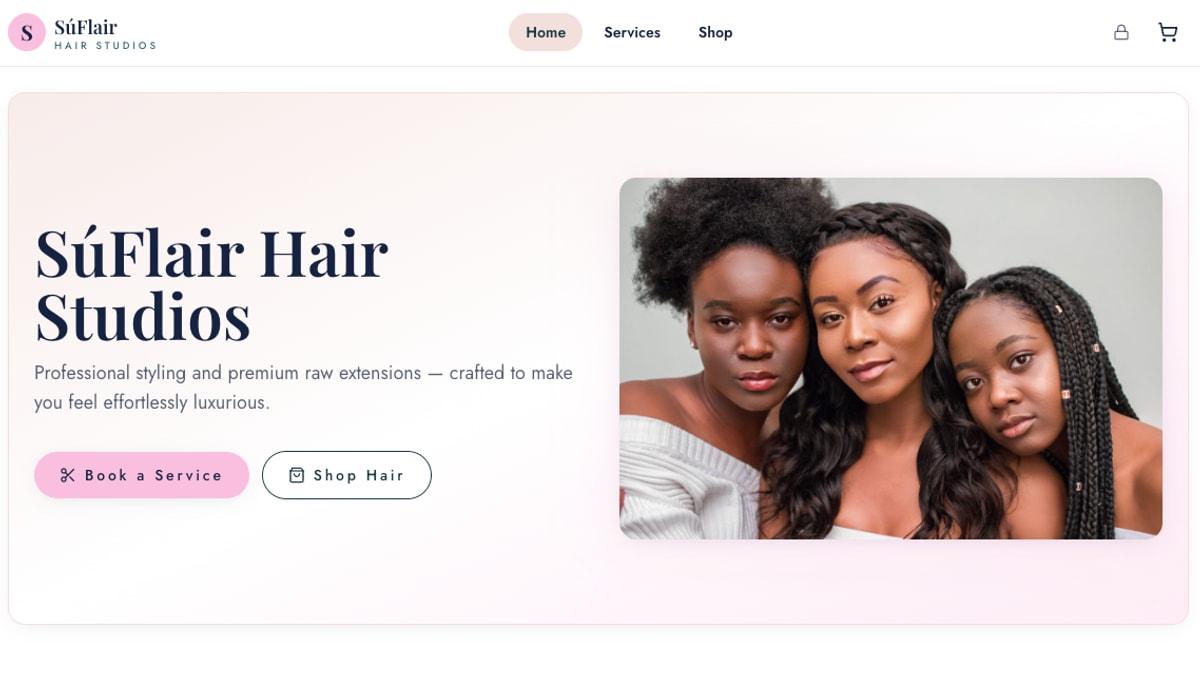
Overview
SúFlair Hair Studios needed one place where clients could both book salon appointments and buy hair extensions, and where the owner could manage services, inventory, and orders without touching code. The result is a single mobile-first application on AWS: a public storefront, Stripe-powered checkout, appointment booking, and a Cognito-protected admin portal.
The problem
The salon side and the retail side of the business lived in different places. Appointments went through a separate scheduling tool while product enquiries arrived through social messages, which meant no shared record of a customer, no inventory tracking, and no way to see bookings and orders together. Any change to pricing or product availability needed someone technical.
What we built
The storefront and the admin portal were built as one application over a shared data model — service categories, services, products, orders, and booking records — so a customer, an order, and an appointment all resolve against the same source of truth. Checkout runs through Stripe via a dedicated Lambda so no card data touches the application, appointment booking is handled by a second function that records each booking against the customer, and product imagery is served from S3. The admin area sits behind Cognito and lets the owner manage services, inventory, and order status directly. The app also ships with a demo mode: with no backend connected it falls back to local seed data, so the UI can be developed, reviewed, and demonstrated without provisioning AWS resources.
The outcome
Booking, purchasing, and back-office management run through one deployed application on Amplify Hosting, with day-to-day catalogue and inventory changes now handled by the owner rather than requiring a developer. The service and product catalogues, order pipeline (pending through shipped), and booking lifecycle are all modelled explicitly, which leaves the business with structured history it did not have before.